

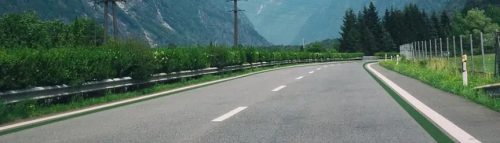
Chances are, you would not have experienced the latest change to road markings on Spain’s roads, the appearance of green lines, because they are currently only being tested on a small number of roads, but if that test proves successful, we may see them appearing more.
The DGT launched a pilot experience on two highways in Palencia in northern Spain, painting green lines on the roads alongside the traditional white lines. So, what is the significance of green lines?
The road traffic collision rate on secondary roads continues to be the great challenge for the General Directorate of Traffic. These are the roads where the highest number of deaths occurs, 75% of the fatalities of all interurban roads.
The DGT focuses its efforts on conventional roads by installing more speed cameras, increasing surveillance and control, and also improving their design.
It is with this objective that the pilot test was been launched on two roads in Palencia, the CL-613 (Palencia-Sahagún) and the CL-615 (Palencia-Guardo), which consists of painting green lines along these highways to help calm traffic.
This pilot experience has been running since 2016 after signing an agreement between the DGT and the Junta de Castilla y León. This initiative has been motivated by the good results obtained in countries such as Sweden and the Netherlands.
In Sweden and the Netherlands, it has been shown that painting these lines green causes traffic calming. They are painted inside the lane, parallel to the continuous white lines that delimit the hard shoulder. The effect it produces is a narrowing of the lane and, consequently, it leads the driver to moderate their speed.
In addition, the green lines are accompanied by vertical signs where drivers are repeatedly informed that they are driving on a road whose speed is being specially controlled.
With this measure, the DGT wants the driver to become aware to the point that the installation of speed control systems is no longer necessary.
What types of roads do green lines run on?
For now, the pilot test has focused on these two roads in Palencia, the CL-613 and CL-615. These are roads with long straight lines, which are in good condition, with a width that varies between 3 and 3 and a half metres, with wide-radius horizontal curves, and, in general, with a low risk.
These conditions can lead to an excessive, and erroneous, sense of control on the part of the driver that leads to exceeding the established speed limits.
For the DGT, this type of improvement in road design allows, at a low cost, to achieve very good results in terms of reducing incidents.
In 2018, 994 people lost their lives in incidents that occurred on secondary roads, with exiting the road being the incident that causes the most victims (38%), followed by frontal crashes (27%) and fronto-lateral crashes (16%). 52% of those who died on these roads were traveling in a car, 19% on a motorcycle, 8% were pedestrians, 6% were in vans and 4% were riding a bicycle.


Alert: risk of fire in Citroën, DS and Peugeot batteries
According to OCU, the battery failure could affect up to 70,000 vehicles. OCU reminds that the fault must be corrected by the affected brands free of charge. Extended information: with


