–> PPPEEE000ECO1508FOTOTF.jpg
20170815
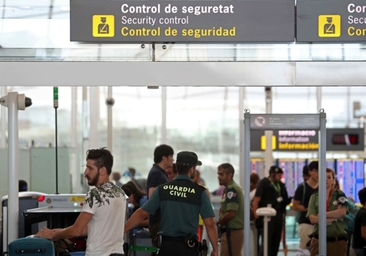
CAPTION IPTC: GRA073. EL PRAT DE LLOBREGAT (BARCELONA), 14/08/2017.- Agentes de la Guardia Civil custodian los accesos a las puertas de embarque en el aeropuerto de Barcelona tras iniciarse a medianoche la huelga indefinida de los trabajadores de Eulen, para la que el Gobierno ha decretado unos servicios mínimos del 90 por ciento. En las líneas de control de los pasajeros que acceden a la instalación se han situado ya efectivos del Instituto Armado que refuerzan el servicio prestado por los empleados de Eulen después de que el Ejecutivo tomara esta decisión para minimizar los problemas de seguridad y orden público que podrían producirse en El Prat debido a la huelga. EFE/Toni Albir
SOURCE: Agencias
CATEGORY: /$ECONOMIA
SUPPLEMENTALCATEGORY: Transporte aéreo Fuerzas de seguridad Conflictos laborales
KEYWORDS: Trabajo Conflictos laborales Labour Labour dispute Economía negocios y finanzas Transporte Transporte aéreo Economy business and finance Transport Air transport Justicia e interior Fuerzas de seguridad Crime law and justice Police
HUELGA INDEFINIDA EULEN
AENA, the company that manages Spain’s main airports has announced that passengers at its airports will no longer have to take out liquids and electronic devices from their luggage and place them into separate security trays in 2024, due to the plans to install new 3D scanners at security checkpoints.
Passengers will also be able to take liquids greater than 100ml in their hand luggage on flights from Spain, meaning they will be able to travel with bottles of wine or olive oil in their on-board luggage.
AENA said the 3D X-ray scanners, equipped with new technologies that analyse the contents of luggage in detail, will be put into use in 2024 – and possibly even before the end of 2023 at some airports.
Madrid Barajas and Barcelona El Prat airports, which both account for 40% of passenger traffic in Spain, will be the first airports to receive the new scanners, and they will be installed at Palma de Mallorca by the end of 2024.
After this, the new 3D X-ray scanners will be installed at Malaga Costa del Sol in 2025, then Gran Canaria, Tenerife Sur, Fuerteventura, Cesar Manrique Lanzarote, Alicante-Elche Miguel Hernandez, Ibiza, Bilbao, Menorca and Valencia from 2026.
AENA will tender for the purchase of the 3D X-ray scanners this year. The company will have invested a total of €1.17 billion to include renewing baggage control and security devices between 2018 and 2028.
The 3D scanners have already been successfully tested in more than a dozen airports in the US and next year they will be available in Europe, including Spain. The enhanced scanners are also being implemented in the Netherlands and in Finland.
Since 2006, liquids had been banned in hand luggage after a failed terrorist plot on flights from London. The terrorists planned improvised explosive devices hidden in soft drink bottles. The 100ml limit up to now has covered liquids and most types of pastes, gels and emulsions.
The UK government has also announced that it will be using the new scanners from June 2024 and Ireland is testing them at airports in Dublin and Cork.
It is hoped that the new rules will speed up growing queues and delays at security that often result in chaos during the summer at many airports.