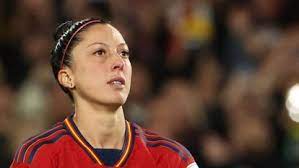
Madrid’s National Court has witnessed a significant development as Spanish footballer Jenni Hermoso appeared to testify in the sexual assault case against the former president of the country’s football federation, Luis Rubiales. The case revolves around an incident where Hermoso was forcibly kissed on the lips by Rubiales following Spain’s victory over England in the Women’s World Cup Final in Sydney last August.
Hermoso, the record scorer for Spain’s women’s team, provided her version of the events during a closed-door testimony, with the court refraining from releasing details about her statements. Spanish media reported from unconfirmed sources that she mentioned the kiss was not consensual during her testimony and revealed that she had been ‘harassed’ and ‘pressured’ to claim the incident was consensual. The 33-year-old athlete had previously mentioned receiving threats in the aftermath of the controversial kiss, although she did not provide further details.
The incident triggered widespread outrage in the football community and led to one of the worst crises in the history of Spanish football. It prompted a boycott of the national team by World Cup-winning players and ultimately led to the resignation of Rubiales, despite his denial of any wrongdoing and his assertion that the kiss was consensual. As part of the legal proceedings, Rubiales is banned from going within 200 meters of Hermoso.
The Spanish state prosecutors have charged Rubiales with sexual assault and coercion, alleging that he tried to persuade Hermoso and her relatives to publicly downplay the incident. The court is also gathering testimony from other World Cup-winning players, coaches, and federation officials before deciding whether to proceed to trial.
Among those investigated for allegedly trying to pressure Hermoso are former Spain women’s national team coach Jorge Vilda and other former federation officials. Rubiales had previously denied wrongdoing to the judge who imposed a restraining order on him, preventing any contact with Hermoso.
Under a sexual consent law passed last year, Rubiales could face a fine or a prison sentence of one to four years if found guilty, as the law eliminated the distinction between ‘sexual harassment’ and ‘sexual assault’, penalizing any unconsented sexual act. FIFA has also imposed a three-year ban on Rubiales, effective until after the men’s 2026 World Cup, with his ban set to expire before the next women’s tournament in 2027. Rubiales resigned as the federation president and UEFA vice president on 10th September amid mounting pressure from lawmakers and players, and a day later, UEFA expressed gratitude for his service.