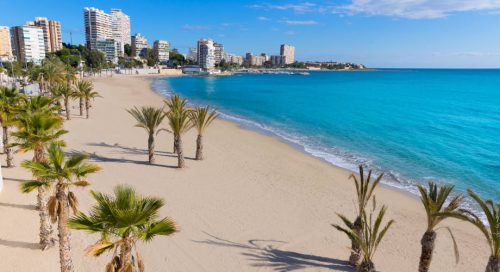
A new book by professors Joan Romero and Jorge Olcina warns that sea temperature here has risen by 1.3 degrees since 1982, three times more than that of the air.
The increase in the temperature of the Mediterranean Sea, specifically along the coast of the province of Alicante where during the summer the water reaches maximum temperatures of 28/29 degrees, has become the focus of great concern of scientists studying climate change in the Alicante region.
In the last 40 years, the average temperature of the sea off the coast of Alicante has increased by 1.3 degrees. The rise in temperature in the medium and long term will have significant consequences for the busy stretch of coast, where 60% of the provincial population resides. Action is urgently needed, according to climatologist Jorge Olcina, who together with Professor Joan Romero, from the University of València, edited the book “Climate Change in the Mediterranean, processes, risks and policies”; a publication in which experts from a variety of disciplines analyze the consequences of climate change.
Olcina says that the warming of the sea has not stopped since 1982, and to address the problem will require taking difficult but necessary action. He explained, “Climate change is going to cause us to have a great maritime storm every two or two and a half years, when 20 years ago they were much less frequent. They will also be more intense, and not only in the generation of torrential rain, but in the greater intensity of the sea beating against the coast. For this reason, it is urgent that the 2013 Coastal Law be revised, which extended concessions for homes and businesses for up to 75 more years. It is not that the sea level will rise excessively, but it will increase the intensity, strength and frequency of the storms.”
Olcina added that we can expect, “A significant increase in atmospheric extremes with episodes of intense rain, and more intense periods of drought, of shorter duration but more frequent in onset. The presence of an increasingly warmer sea in the Mediterranean basin plays a decisive role in these regional manifestations of climate warming.”
The increase in sea temperature is, according to Jorge Olcina, a key factor in episodes of instability such as the ‘gota fria’ and heavy torrential rains over such a short space of time that it is difficult for the land to retain water. The situation, according to the new publication, contrasts with what the current prediction models indicate, which forecast a reduction in ‘normal’ rainfall, decreasing circulation of water in the Júcar and Segura rivers by between 8% and 10%. “The rains will accumulate on the coast and not inland,” warns Olcina.
In the book, Professors Romero and Olcina analyze climate change, its socioeconomic and territorial impact. The book brings together the diagnosis and the solutions presented by 20 specialists brought together under the framework of a seminar organized by the Prospect Valencian Community 2030 Chair. It aims to provide information to inform both government and citizens in order that we can all take steps to mitigate the effects of change climate in the Mediterranean.