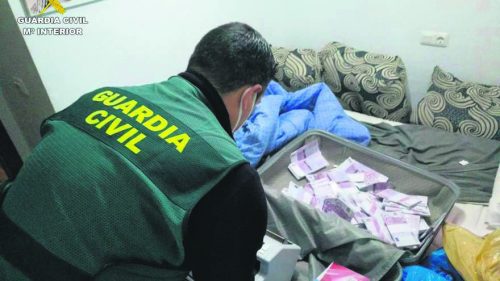
Guardia Civil in Torrevieja have arrested four people aged between 30 and 47 years old and all members of the same family, for defrauding €50,000 euros through a scam known as a ‘rip deal’. During a series of searches as part of the operation, officers seized more than one and a half million euro in false €500 notes, €2,600 in genuine notes, a number of high-end watches and jewellery, two money counting machines, two printing machines, a large amount of mobile phones and mobile phone cards as well as handwritten notes with contact details of potential victims.
Those arrested had pretended to be intermediaries of an international investment fund based in Curaçao. The gang purported to buy out a business in Altea but, at the time of payment, exchanged legal tender bills for counterfeit ones, according to a statement by Guardia Civil.
Investigators said that this gang is a “very active” criminal group, the leader of the family known in various parts of Spain, such as Madrid, Catalonia and the Basque Country. The gang even collaborated with other crime families to carry out scams.
The gang were particularly active in Alicante and Murcia, and at the time of arrest they appeared to have several scams planned using the same method, one of which was imminently targeting a Murcian businessman.
The investigation began when a businessman from Altea told the Guardia Civil that he had been the victim of a €50,000 scam, money that was due to be exchanged between him and the alleged buyers of a company he owned.
After the first contact between the criminal gang and the business owner, a person posing as a manager of an investment fund (who in reality was the leader of the crime family), would hold several meetings in offices rented by the scammers to give the outward appearance of a genuine business.
In addition, the gang members wore designer clothing and even high-end watches at meetings to reinforce the image of wealthy investors.
After several meetings and before closing the main deal, the scammers revealed that ‘as a favour’ they would negotiate a further €50,000 in cash, to be handed over in €500 bills on the condition that these be exchanged by the victim for bills of a smaller denomination. In this instance, the victim started to count the money to check on the spot that it was the correct amount. However, faced with the overwhelming sum of money, the alleged buyers offered him the use of their counting machine to speed up the count, a request to which he agreed. It was here when the scammers cleverly exchanged real money for fake bills.